
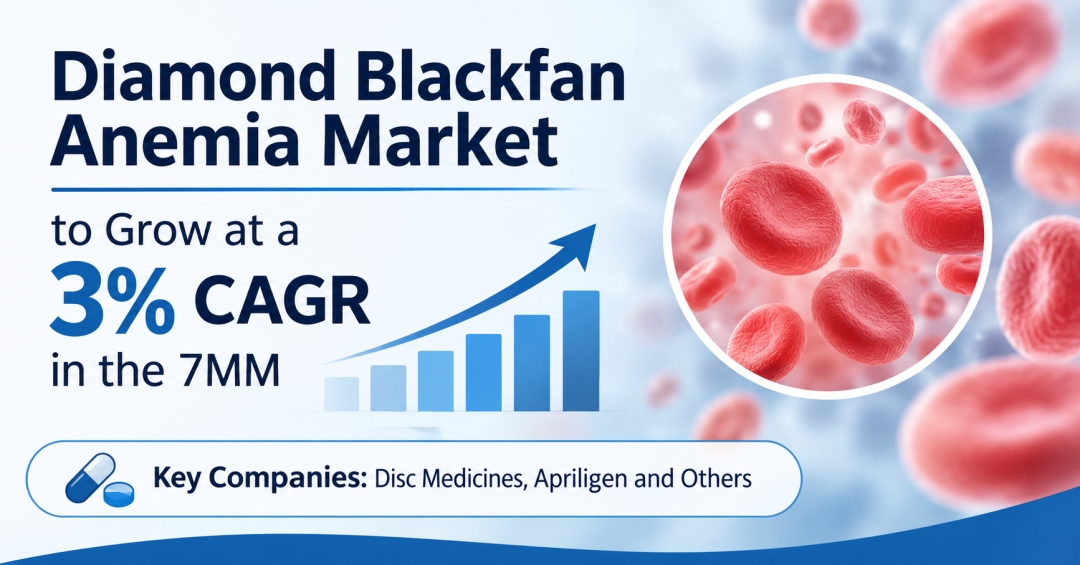
Diamond Blackfan Anemia Market Size in the 7MM is projected to grow at a 3% CAGR over the forecast period of 2026-2036 | DelveInsight
(Albany, US), November 11, 2026 – DelveInsight’s ‘Diamond Blackfan Anemia Market Insights, Epidemiology and Market Forecast – 2036’ report delivers an in-depth understanding of Diamond Blackfan Anemia, historical and forecasted epidemiology, as well as the Diamond Blackfan Anemia market trends in the United States, EU4 (Germany, Spain, Italy, and France) and the United Kingdom, and Japan.
Explore the intricate details of the Diamond Blackfan Anemia Market Report @ Diamond Blackfan Anemia Syndrome Therapeutic Market
Key Takeaways from the Diamond Blackfan Anemia Market Report
-
In July 2026, Apriligen, Inc. announced result of A Phase 1, Open-label, Single-arm Study of APR 2020 in Transfusion Dependent, Steroid Resistant Pediatric and Adolescent Subjects With RPS19 Deficient Diamond Blackfan Anemia by Transplantation of Autologous CD34+ Stem Cells Transduced With CLIN LV EFS coRPS19 PRE* (APR-2020).
-
According to DelveInsight’s analysis, among the 7MM, the United States was found to have the largest Diamond Blackfan Anemia market size in 2025.
-
The Diamond Blackfan Anemia market size in the 7MM was approximately USD 1.6 million in 2025 and is expected to grow at a CAGR of 3% during 2026-2036.
-
Among the 7MM, the United States accounted for the highest number of Diamond Blackfan Anemia diagnosed prevalent cases in 2025, with nearly 6,000 cases, and these cases are anticipated to increase by 2036.
-
In the United States, the RPS19 mutation accounted for ~25% of Diamond Blackfan Anemia cases by mutated gene in 2025.
-
Approximately 75% of DBA cases involve heterozygous mutations in ribosomal protein genes, classifying it as a ribosomopathy, with RPS19 being the most frequently mutated gene.
-
Among the EU4 and the UK, approximately 25% of Diamond Blackfan Anemia cases in 2025 were of the craniofacial type, followed by cases with musculoskeletal, urogenital, and other congenital anomalies.
-
Hematopoietic stem cell transplantation (HSCT) is currently the only curative option for DBA, but it is limited by the availability of suitable donors and associated risks.
-
The leading Diamond Blackfan Anemia companies include Disc Medicines, Apriligen, and others.
-
Promising Diamond Blackfan Anemia therapies include Bitopertin, APR-2020, and others.
Get a Free sample for the Diamond Blackfan Anemia Market Forecast, Size & Share Analysis Report @ Diamond Blackfan Anemia DBA Treatment Market
Diamond Blackfan Anemia Overview
Diamond Blackfan Anemia (DBA) is a rare inherited bone marrow disorder that typically presents in infancy and is characterized by a failure of red blood cell production due to mutations in ribosomal protein genes. It leads to severe macrocytic anemia with symptoms such as pallor, fatigue, poor feeding, and growth delay. Around 40%–50% of patients also have congenital abnormalities, including craniofacial defects, thumb malformations, short stature, and cardiac anomalies. The disease varies in severity and may also be associated with developmental issues and an increased risk of malignancies later in life. Diagnosis is based on clinical presentation and laboratory findings, typically identified in infancy, and is characterized by severe macrocytic anemia with very low reticulocyte counts, while white blood cells and platelets are usually normal. Bone marrow examination shows a marked reduction or absence of erythroid precursors. Elevated fetal hemoglobin (HbF) levels and increased erythrocyte adenosine deaminase (eADA) activity are supportive findings, and confirmation is achieved through genetic testing, which identifies mutations in ribosomal protein genes in the majority of cases.
Diamond Blackfan Anemia Epidemiology Segmentation in the 7MM
-
Total Diagnosed Prevalent Cases of Diamond Blackfan Anemia
-
Total Diagnosed Prevalent Cases of Diamond Blackfan Anemia by Mutated Gene
-
Total Diagnosed Prevalent Cases of Diamond Blackfan Anemia by Congenital Anomaly
-
Total Treated Cases of Diamond Blackfan Anemia
Download the report to understand which factors are driving Diamond Blackfan Anemia prevalence trends @ Diamond Blackfan Anemia Prevalence
Diamond Blackfan Anemia Epidemiology Key Findings
-
Among the 7MM, the United States accounted for the highest number of Diamond Blackfan Anemia diagnosed prevalent cases in 2025, with nearly 6,000 cases. These cases are anticipated to increase by 2036.
-
In the United States, the RPS19 mutation accounted for ~25% of cases in 2025 among Diamond Blackfan Anemia cases by mutation.
-
Among the EU4 and the UK, approximately 25% of Diamond Blackfan Anemia cases in 2025 were reported to be of the craniofacial type, followed by cases with musculoskeletal, urogenital, and other congenital anomalies.
-
In Japan, among the congenital anomalies associated with Diamond Blackfan Anemia, craniofacial anomalies were the most prevalent, with almost 50 cases reported in 2025, followed by musculoskeletal anomalies.
Current Treatments for Diamond Blackfan Anemia
Currently, no therapies are specifically listed as approved for Diamond Blackfan Anemia in the source. Treatment primarily focuses on managing anemia and maintaining adequate hemoglobin levels. First-line therapy typically involves corticosteroids, which can stimulate red blood cell production in many patients. Those who do not respond or cannot tolerate steroids often require regular blood transfusions, which may lead to iron overload over time and necessitate iron chelation therapy. HSCT is currently the only curative option, particularly for severe or transfusion-dependent cases. Supportive care and long-term monitoring are essential due to potential complications and disease variability.
Diamond Blackfan Anemia Pipeline Analysis
-
Bitopertin: Disc Medicines
Bitopertin is an oral, selective inhibitor of GlyT1, a key membrane transporter required to supply developing red blood cells with sufficient glycine to support heme synthesis. Heme biosynthesis is a multistep, enzymatic process that begins with glycine, which is a critical component of heme. By limiting glycine uptake, bitopertin can regulate downstream heme synthesis. These hematologic effects have been established in numerous preclinical and clinical studies of bitopertin. Disc obtained global rights to bitopertin under a license agreement from Roche in May 2021. In July 2023, Disc Medicine announced that the first patient had been enrolled in the National Institutes of Health-sponsored Phase I/II clinical trial of bitopertin in steroid-refractory DBA, positioning it as a notable emerging DBA medicine.
-
APR-2020: Apriligen
APR-2020, Apriligen’s lead therapeutic candidate, is an autologous solution for RPS19-deficient DBA patients. It has been granted Orphan Drug, Rare Pediatric Disease, Fast Track and Rare Disease Evidence Principles (RDEP) designations by the US FDA and Orphan Drug Designation by the EMA. The IND for APR-2020 was filed with the FDA in August 2025, and in September 2025, the FDA issued Apriligen a safe to proceed letter. Phase I clinical trials of APR-2020 began in 1Q2026, with trial sites selected in the United States. European trial sites are expected to open towards the end of 2H2026.
Discover more about therapies set to grab major Diamond Blackfan Anemia Market Share @ Shwachman Diamond Syndrome Market
Diamond Blackfan Anemia Market Outlook
DBA is a rare blood disorder diagnosed in infancy, where the bone marrow fails to produce enough red blood cells. Current treatments, including glucocorticosteroids, blood transfusions, and HSCT, have limitations. Steroids can lose effectiveness over time and cause severe side effects, such as osteoporosis and diabetes. Blood transfusions risk iron overload, while HSCT, the only curative treatment, presents challenges like finding compatible donors and immunological complications. Recent advances in gene therapy, particularly lentiviral vector–based approaches, offer promising potential by delivering functional copies of mutated genes into patients’ cells, and ongoing research, including CRISPR/Cas9 gene editing strategies, aims to correct the underlying genetic defects driving the disease. Growing research in ribosomal protein gene mutations, a robust pipeline, and increasing clinical trial activity are expected to shape the anemia drugs market, and the Diamond Blackfan Anemia treatment market is expected to increase during the forecast period (2026–2036). The United States accounted for the largest Diamond Blackfan Anemia market size in 2025.
Diamond Blackfan Anemia Market Drivers
-
Rising awareness and early diagnosis
-
Advancements in genetic and molecular research
-
Emerging novel therapies, including gene therapy and stem cell-based therapies
-
Increasing healthcare expenditure and improved reimbursement frameworks
-
Strong pipeline and clinical trial activity
-
Role of patient advocacy groups
-
Expansion of healthcare infrastructure in emerging markets
Diamond Blackfan Anemia Market Barriers
-
Lack of curative therapies
-
Transfusion burden and iron overload
-
Delayed or missed diagnosis
-
Steroid-related toxicity and loss of steroid effectiveness over time
-
Limited availability of suitable HLA-matched donors for HSCT
Diamond Blackfan Anemia Treatment Landscape
The primary focus of Diamond Blackfan Anemia treatment is managing anemia and maintaining adequate hemoglobin levels. Corticosteroids improve anemia and red blood cell counts in about 80% of patients with DBA, but they are strong medicines with potentially serious side effects, and steroid therapy may be lifelong for many patients. Approximately 80% of patients are initially responsive to corticosteroids, whereas 20% will not respond and will require red blood cell transfusions. Blood transfusions are often needed for anemia at diagnosis and usually for the first year of life, and may be given every three to four weeks; for patients who do not respond to steroids, transfusions are lifelong, along with management of iron overload. Stem cell transplant, if an appropriately matched donor is found, can alleviate the anemia of DBA, but rejection or infection is possible, so it is usually only done if steroids are not effective and the patient is receiving red cell transfusions every 3-4 weeks. These patients may also be candidates for potential gene therapy.
To know more about Diamond Blackfan Anemia Companies working in the treatment market, visit @ Bantis Syndrome Treatment Market
Scope of the Diamond Blackfan Anemia Market Report
-
Coverage- 7MM
-
Study Period- 2022-2036
-
Forecast Period- 2026-2036
-
Diamond Blackfan Anemia Companies- Disc Medicines, Apriligen, and others.
-
Diamond Blackfan Anemia Therapies- Bitopertin, APR-2020, and others.
-
Diamond Blackfan Anemia Market Dynamics: Diamond Blackfan Anemia market drivers and market barriers
-
Diamond Blackfan Anemia Competitive Intelligence Analysis: SWOT Analysis, Conjoint Analysis
-
Diamond Blackfan Anemia Unmet Needs, KOL Views, Reimbursement
Table of Contents
-
Key Insights
-
Report Introduction
-
Executive Summary of Diamond-Blackfan Anemia
-
Key Events
-
Epidemiology and Market Forecast Methodology
-
Diamond-Blackfan Anemia Market Overview at a Glance
-
Disease Background and Overview of Diamond-Blackfan Anemia
-
Treatment and Management of Diamond-Blackfan Anemia
-
Treatment Guidelines
-
Epidemiology and Patient Population of Diamond-Blackfan Anemia
-
Patient Journey of Diamond-Blackfan Anemia
-
Emerging Drugs
-
Diamond-Blackfan Anemia: 7MM Analysis
-
Unmet Needs of Diamond-Blackfan Anemia
-
SWOT Analysis of Diamond-Blackfan Anemia
-
KOL Views of Diamond-Blackfan Anemia
-
Market Access and Reimbursement of Diamond-Blackfan Anemia
-
Appendix
-
DelveInsight Capabilities
-
Disclaimer
-
About DelveInsight
Media Contact
Company Name: DelveInsight Business Research LLP
Contact Person: Abhishek kumar
Email: Send Email
Phone: +19193216187
Address:304 S. Jones Blvd #2432
City: Albany
State: New York
Country: United States
Website: https://www.delveinsight.com/report-store/diamond-blackfan-anemia-dba-aase-syndrome-market


